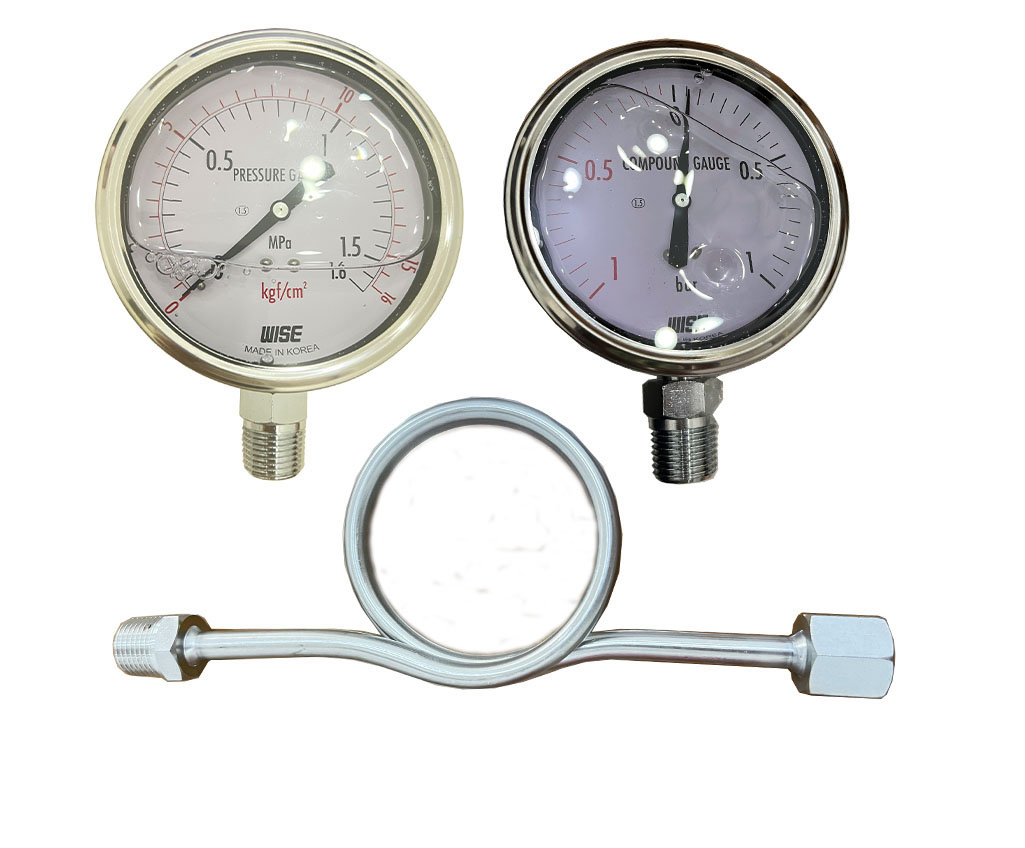
1. Product Overview
Pressure gauges and vacuum gauges are instruments used to measure the pressure of fluids (liquids or gases) inside pipelines or tanks.
- Pressure Gauge: Measures positive pressure (above atmospheric pressure).
- Vacuum Gauge: Measures negative pressure (below atmospheric pressure).
- Compound Gauge: A combined type that can measure both negative and positive pressure on the same dial.
2. Standard Technical Specifications
| Feature | Technical Details |
|---|
| Case Material | Stainless steel 304/316 (corrosion-resistant) or black steel |
| Connection Stem | Brass or stainless steel 316 |
| Dial Size | 63 mm (2.5″), 100 mm (4″), 150 mm (6″) |
| Measuring Range | From -1 bar to 0 bar (vacuum) or 0 bar to 1000 bar (pressure) |
| Accuracy Class | 1.0%, 1.6%, or 2.5% |
| Connection Type | Bottom connection or back connection |
| Internal Medium | Glycerin-filled or dry |
3. Why Use Glycerin-Filled Gauges in Fuel Systems?
In pumping stations, glycerin-filled gauges provide significant benefits:
- Anti-vibration needle: Pump operation generates high vibration, causing the needle to oscillate. Glycerin dampens movement, ensuring accurate readings.
- Protects internal mechanism: Lubricates gears, reduces friction, and prevents wear, extending gauge lifespan.
- Prevents condensation: Stops moisture from fogging the glass or corroding internal components.
4. Key Features
- Bourdon tube sensor: High-sensitivity stainless steel or brass Bourdon tube provides instant pressure response.
- Safety design: Equipped with a blow-out disk at the back to prevent glass rupture under sudden overpressure.
- Temperature resistance: Operates reliably between -20°C and +60°C.
- Dual units: Dial typically displays both bar and psi or kg/cm² simultaneously.
5. Practical Applications
- Pump discharge line: Monitors working pressure to prevent pump overload or pipeline blockage.
- Pump suction line: Vacuum gauges check suction pressure to detect clogged strainers or fuel shortage.
- Pressure tanks: Ensures safe monitoring of internal tank pressure to prevent explosion hazards.
- Filtration systems: Installed before and after filters to track pressure drop, indicating when cleaning is required.
Pressure gauge, vacuum gauge
Đánh giá bài viết!